
For a Mess Hall Harlem guest list, confirm the entry instructions for the specific event before you go; do not assume that every event requires registration or that every event accepts walk-ins. Get a clear answer about whether you need your name on a list, whether your guests need separate confirmation, and what to show when you arrive.
- For a Mess Hall Harlem guest list, confirm the specific event’s entry instructions before making plans.
- An RSVP, guest-list entry, and table reservation mean different things; ask which confirmation you need.
- Confirm whether your response covers your whole group or only your own admission.
- Keep the event details and any confirmation together so you can find them at the door.
Do you need to be on a guest list for events at Mess Hall Harlem?
Confirm the requirement for your exact event rather than treating guest-list entry as a standing rule. When planning a visit in 2026, use instructions that name the event and date you intend to attend. A general invitation to come out does not answer whether registration is required.
Start with Mess Hall Harlem and the information attached to the event you have in mind. If the wording does not explain how entry works, ask directly before submitting names or inviting friends.
Check which kind of confirmation you have
These terms describe different arrangements. Use the comparison below to identify what your message actually confirms, not to infer a policy for the bar.
| Arrangement | What it describes | Best for | Limit to check |
|---|---|---|---|
| Guest list | A named record of expected attendees | Checking whether your name is recorded | Whether it covers admission, companions, or an arrival condition |
| RSVP | Your response to an invitation | Telling the organizer you intend to attend | Whether a response alone completes registration |
| Table reservation | An arrangement concerning seating | Planning where a group will sit | Whether event entry needs separate confirmation |
| Private invitation | An invitation addressed to a person or group | Understanding who has been invited | Whether guests can bring additional people |
Each arrangement answers a different question. A table reservation concerns seating; a guest-list instruction concerns names. Ask about both when both matter to your plans.
Why this matters
A good neighborhood night out should not start with your group sorting through conflicting messages outside the door. Clear instructions let you spend less time coordinating and more time enjoying the evening.
The key distinction is between wanting to attend and having completed whatever the event asks you to do. Sending a message expresses interest; a reply confirming the required action gives you something concrete to follow.
For your 2026 plans, keep the event name, date, entry instructions, and confirmation in the same place. That makes it easier to notice when a message concerns a different evening or leaves an important question unanswered.
How do you confirm whether you need a guest list?
Use this sequence before you finalize your plans. It works whether you are heading out alone, meeting a date, or coordinating friends.
Read the event details
Find the announcement for the exact event you want to attend. Read the full wording, including any instructions attached to registration or arrival, rather than relying on a cropped image or a friend's summary.
Look for language that tells you to take an action: RSVP, register, submit a name, or wait for confirmation. Treat an unanswered question as something to clarify, not permission to substitute your preferred arrangement.
Ask about entry
Ask whether your name needs to be recorded before you arrive. Include the event name and date so the answer concerns your actual visit.
Keep the question narrow. Asking whether you need a guest list is clearer than asking whether everything is all set, especially if your earlier conversation also covered seating or a celebration.
Confirm your group
State how many people you intend to bring, without assuming that your own confirmation extends to everyone. Ask whether the organizer needs individual names or a single response covering the group.
If friends are arriving separately, include that detail in your question. You want instructions each person can follow without needing to reconstruct the entire conversation at the entrance.
Save the reply
Keep the final response with the event details. If the reply asks you to complete another action, do that before treating your plans as confirmed.
A useful record identifies the event and explains what you need to do. A screenshot without the date or surrounding instructions is less useful than the complete exchange.
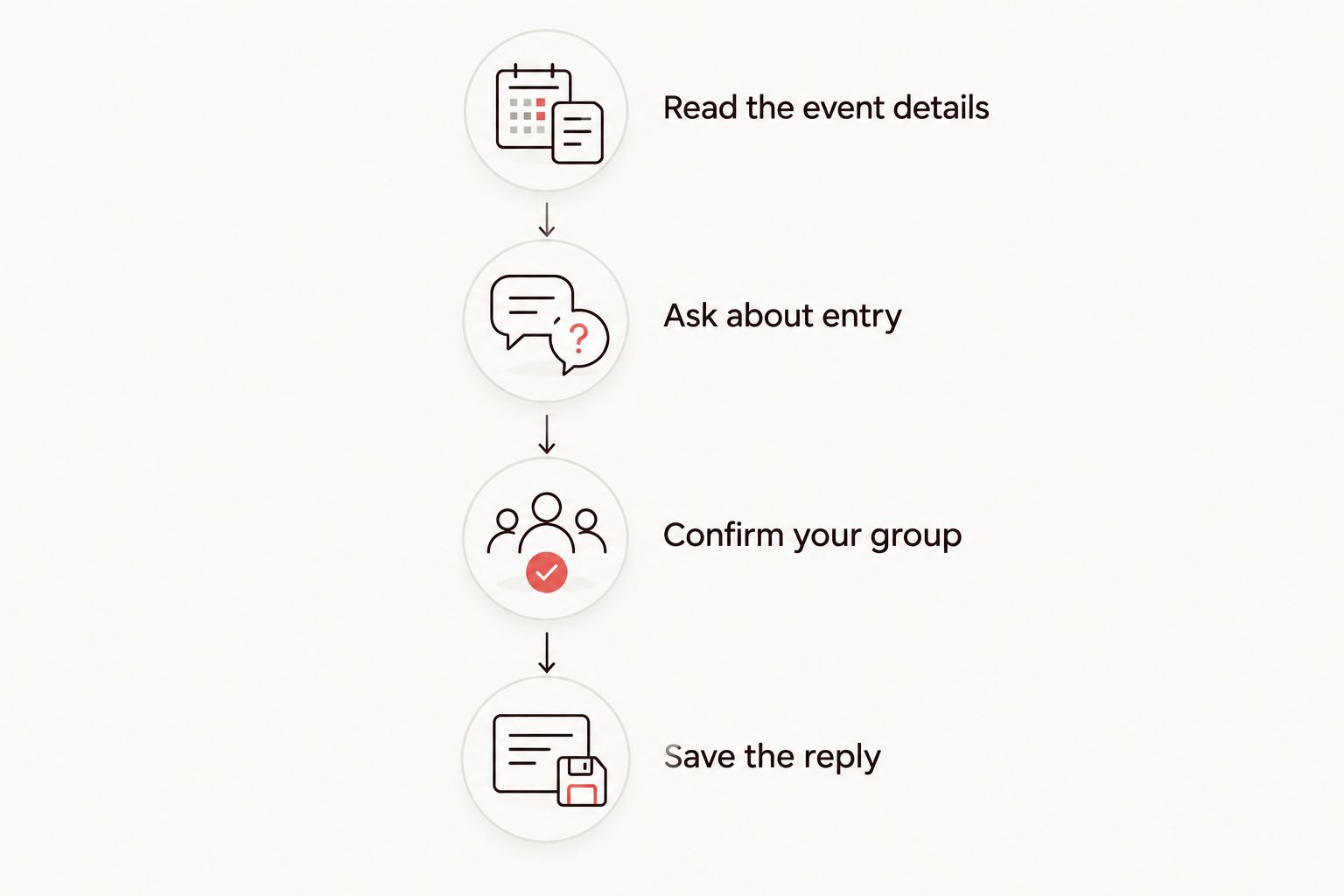
The goal is a clear instruction, not a long conversation. Once you know what is required and have completed it, share that instruction with anyone joining you.
What should you ask before putting your name on a list?
A short message gives the person answering enough context without burying the main question. Include the event, its date, your intended group size, and the point you need clarified.
You can adapt this message:
Hello, I’m planning to attend the event on the date listed in the announcement. Do I need to be on a guest list? Please also confirm whether each person in my group needs to register separately and what we should show when we arrive.
Replace the general references with your actual details before sending it. This is suggested wording for your own inquiry, not a statement of the venue's policy.
Use the contact page when you need to ask the bar directly. If your invitation identifies a separate organizer, ask who is responsible for confirming the list so you know whose response settles the question.
Avoid sending different versions of the same request without connecting them. If your plans change, reply with the updated details and ask whether your earlier confirmation still applies.
What makes event-entry instructions different?
Read the wording of the actual invitation rather than deciding based on the type of night you expect. The following details define what you need to clarify; they are not standing entry rules for the venue.
- Named event: Make sure the response refers to the event you intend to attend, not a general visit.
- Event date: Check that the announcement and confirmation concern the same evening in 2026.
- Named attendees: Ask whether the response covers you alone or includes the people joining you.
- Required action: Separate an invitation to respond from confirmation that your response has been accepted.
- Arrival instructions: Follow any stated check-in direction, and ask about wording you do not understand.
- Separate arrangements: Confirm whether seating, a private invitation, or another booking needs its own entry instructions.
Follow the instruction that applies to your booking, not an assumption borrowed from another night. Your friend's previous experience does not establish the terms of your event.
Is an RSVP the same as being on the guest list?
An RSVP and a guest-list confirmation describe different things: your response and a record of attendees. Ask whether submitting the RSVP completes the required process or whether you should expect a separate acknowledgment.
Read the response for a completed action. A message that says your inquiry was received answers a different question from a message confirming that your name has been recorded.
For a 2026 event, check that any acknowledgment names the correct date. If the reply only repeats your question or directs you elsewhere, complete that next step before telling friends that entry has been confirmed.
Does a table reservation cover event admission?
A table reservation concerns seating; ask separately whether it satisfies the event's entry requirements. Do not treat a reservation reference as proof that every person in your party has completed any required registration.
Keep both questions in the same exchange when possible. Explain that you want to confirm the seating arrangement and understand what each attendee must do on arrival.
If the event instructions make no connection between reservations and guest-list entry, ask rather than filling in the gap yourself. That is especially useful when the person organizing the table is not the person coordinating the rest of the group.
Can you bring friends who are not named in your confirmation?
Ask before adding people who are not covered by the reply you received. Give the updated group details and request a clear answer about whether additional names or responses are needed.
Do not forward your confirmation as though it automatically applies to someone else. Share the event instructions instead, then explain which parts have been confirmed for your group.
If someone joins the plan later, make that change explicit. A short update is easier to answer than a message that assumes an earlier response covers a different group.
What should you keep ready before leaving?
Keep the information that answers the entry question together. You do not need to turn a casual night out into an administrative project, but you should be able to find the instructions you agreed to follow.
- The event name and date.
- The final entry instructions.
- Any response confirming your registration or names.
- The details of who your confirmation covers.
- Any separate seating or group-arrival instructions.
Share the relevant details before friends set off, particularly if you will arrive separately. Tell them what is confirmed and what action, if any, each person still needs to complete.
Do not replace specific instructions with a broad promise that everyone is sorted. Clear information is more helpful than confidence unsupported by the actual reply.
Is this the right bar for your plans?
Mess Hall Harlem is best for locals and visitors seeking a casual Central Harlem neighborhood bar with craft beer, bourbon, and original cocktails. That describes the setting and drinks, not a promise about event admission.
The benefit is a straightforward neighborhood-bar choice for a relaxed night out. The planning limit is equally straightforward: the bar's general description does not settle the entry requirements for a particular event.
For your 2026 visit, keep those decisions separate. First decide whether the setting suits your night; then confirm the instructions attached to the event you want to attend.
FAQ
Do I need a guest list for every event at Mess Hall Harlem?
Confirm the requirement for your specific event rather than assuming a rule applies to every night. Ask whether your name must be recorded and what completes that process.
Can I just walk in if I haven’t received a reply?
Do not treat an unanswered inquiry as confirmation of entry. Ask for clear instructions before making plans that depend on attending the event.
Does sending an RSVP mean my name is confirmed?
Check whether the RSVP response confirms registration or asks you to complete another step. Sending your details and receiving confirmation are different actions.
Does my guest-list confirmation include my friends?
Confirm exactly who your response covers. Ask whether friends need individual registration or whether the organizer accepts a response for the whole group.
Do I need a table reservation as well as a guest list?
Ask separately about seating and event entry. A table reservation describes a seating arrangement and does not, by itself, explain the event’s registration requirements.
What should I include when asking about entry?
Include the event name, date, intended group size, and your guest-list question. Ask what each attendee needs to do before arriving.
Should I check an old event announcement for the rules?
Use instructions that match the event and date you intend to attend. An older announcement does not establish the requirements for your current plans.
One last thing
Ask what your confirmation covers, not just whether you are on a list. The useful answer identifies the event, the people included, and any action still required.
That final check keeps a small unanswered detail from becoming the whole group's problem. Once the instructions are clear, pass them along and get back to planning a good night out.


