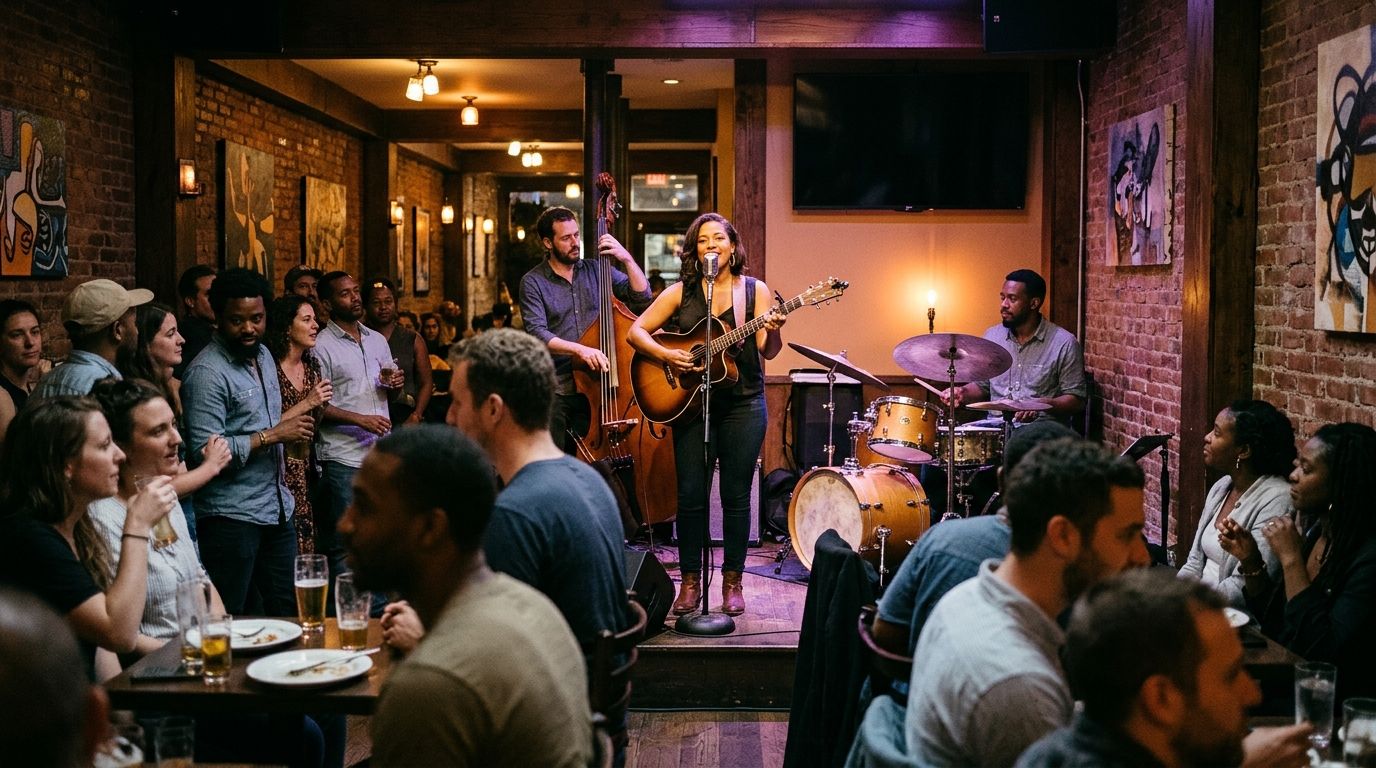
Instead of searching for a live-music announcement every time you make plans, save a confirmed night at Mess Hall Harlem in Google Calendar with the original announcement and a reminder. This guide walks you through a manual calendar entry, then shows you how to update it without creating duplicates or mistaking a personal reminder for a confirmed booking.
- Build your mess hall harlem live music calendar from confirmed announcements, not assumed weekly schedules.
- Google Calendar is best for saving individual nights with reminders; manually created entries do not receive venue updates automatically.
- Confirm the performance date, start time, and New York time zone before saving an event.
- Keep the announcement in the event description, and check it again before leaving.
Why this matters
A saved event solves the forgetting problem. It does not solve the confirmation problem: a calendar entry you create yourself cannot tell you that a performer, start time, or date has changed.
Mess Hall Harlem is best for locals and first-timers seeking a casual Central Harlem neighborhood bar. Craft beer, bourbon, and original cocktails are part of that setting; a particular live-music night still needs its own dated confirmation.
For your 2026 plans, separate those two jobs. Confirm the event first, then let your calendar handle the reminder. That keeps an old announcement from becoming a new plan by accident.
Before you start
- Have calendar access. Sign in to Google Calendar in a desktop browser using the account you actually check. These instructions use the desktop website; mobile layouts differ.
- Have a dated announcement. Gather the performance date, start time, venue location, and original announcement. Use an explicit 2026 date where the announcement supplies one; do not infer the year from when someone shared it.
- Know the gotcha: a saved copy is not a live connection. Typing event details into your own calendar does not subscribe you to venue updates. An image or screenshot also does not establish a recurring schedule.
If the performance date or start time is unclear, stop before creating a timed event. Save a task to confirm the details instead. A reminder to investigate is useful; a confident-looking calendar entry with guessed details is not.
Choose the right calendar setup
Use a single event for a single confirmed performance. A repeating entry belongs only to a schedule explicitly confirmed as recurring, not to a night that happened on the same weekday previously.
| Calendar setup | Best for | Advantage | Limitation |
|---|---|---|---|
| Single event | One confirmed music night | Keeps the date and reminder specific | Requires manual edits if details change |
| Repeating event | An explicitly confirmed recurring series | Avoids entering each occurrence separately | Can preserve canceled or outdated dates unless maintained |
| Shared event with guests | Friends attending the same confirmed night | Gives the organizer one entry to update | Guests must receive and act on invitations or updates |
These are Google Calendar configurations, not different ways to reserve entry. Adding an event to your calendar does not book a table, register attendance, or establish admission terms.
For a one-off outing in 2026, start with the single-event setup below. Add guests only after you have checked the details and decided who will maintain the shared entry.
Event details
Check the source
- Open the announcement you intend to use. Match the venue name and location to the event, especially when a performer posts several appearances together.
- Read the full date, including the year when shown. A weekday alone is not enough to identify a performance.
- Separate the music start time from any other time listed. Doors, a gathering time, and a performance time describe different things.
- Copy the announcement's address and keep its original link. If it is an image without a stable link, keep the image and transcribe the relevant details accurately.
Expected result: you have a source-backed performance date and start time, plus a location you can check before traveling.
Keep personal planning separate from the advertised schedule. If you want to arrive 15 minutes early, that is your arrival preference—not a new performance start time. Put that preference in the description or use a reminder rather than changing the announced start.
If the announcement contains conflicting information, resolve it before inviting anyone. A calendar entry should record the answer, not conceal an unresolved question behind a precise-looking time.
Create the entry
- In Google Calendar on desktop, select Create, then Event.
- Enter an identifiable title, such as the performer name followed by the venue name. If no performer is named, use a plain description rather than inventing an act.
- Select the confirmed date and start time. Open More options if you need the full editor.
- In Location, enter the address from the announcement. Check any suggested location before accepting it.
- In Description, add the announcement link and the details you need to recheck.
Expected result: the draft identifies the right performance, date, and place without requiring you to search your messages again.
A useful description distinguishes confirmed facts from personal plans. Use short lines such as Performance start, Source, Checked on, and Personal arrival plan. For a 2026 event, record the full date you checked the announcement so an older note does not look newly verified.
Do not treat the editor's suggested end time as a published finish time. If the announcement gives no ending, use your own planning end time and explicitly label it as personal in the description.
Time and reminder settings
Set the time zone
- In the full event editor, select Time zone beside the event's time controls.
- Choose the New York time zone for the performance. New York observes Eastern Time, with seasonal daylight-saving changes.
- Check that the event is timed rather than marked All day.
- Leave Does not repeat selected unless you have confirmed a recurring series.
- Review the date and time together before moving on.
Expected result: the performance is tied to its local New York time, even if you view your calendar while traveling.
A visitor's calendar can display the same event in a different local time zone. That is not necessarily an error: compare the event's configured zone with the zone your calendar currently displays before changing anything.
Avoid manually converting the performance into your home time zone and then also selecting New York. Enter the advertised local time once, with the appropriate event time zone. Double conversion creates a believable but incorrect appointment.
Add reminders
- In the event editor, select Add notification.
- Set a planning reminder for 1 day before the event if you want time to coordinate with friends.
- Add another notification for 2 hours before the event if that suits your travel plans.
- Select Save, then reopen the saved event and inspect its title, date, time zone, location, and reminders.
Expected result: the entry appears on the intended calendar with reminders you chose, rather than defaults you never checked.
Those reminder intervals are suggested settings, not venue requirements. Choose intervals that fit your journey and schedule. A notification is useful only if it arrives somewhere you notice it.
Check notification permissions on the device you will carry. Browser notifications, phone notifications, and email delivery are different channels; configuring an event reminder does not automatically enable every channel on every device.
The workflow is straightforward: confirm the announcement, create the entry, check its time, then save a reminder. Verification belongs before automation.
Update the same event when details change
For a changed announcement, edit the existing event rather than creating another one. This keeps your reminder attached to the current plan and prevents an outdated copy from surviving beside it.
- Open the saved event in Google Calendar and select Edit event, shown with the pencil icon.
- Replace the changed date, start time, location, or description with the newly confirmed information.
- Update the source link if the venue or performer issued a replacement announcement. Note the date you checked it.
- Select Save. If you added guests, use the update prompt to send the change to them.
- Reopen the entry and check that the old details are gone.
Expected result: one maintained event represents the current plan, and invited guests receive the update when you send it.
A shared event is best for a group with one person willing to maintain the details. Its advantage is a common entry; its drawback is dependence on that organizer. Separate personal copies do not automatically follow the organizer's edits.
For a cancellation, remove the outing from your active plans and notify anyone you invited. Do not simply silence the reminder while leaving a misleading event on a shared calendar.
What about repeating nights?
Only enable repetition when the published information explicitly confirms a series. Check its start date, frequency, exceptions, and ending before creating the recurrence.
When editing a recurring event, read the scope prompt carefully: changing one occurrence and changing the series have different effects. A canceled performance does not, by itself, establish that every later performance is canceled.
Troubleshooting
The event appears at the wrong hour
Open the entry and check its event time zone against your calendar's display time zone. Correct a wrongly configured zone, but leave a valid local-time conversion alone. For 2026 travel plans, use the performance's actual date rather than calculating a fixed seasonal offset yourself.
The same night appears twice
Compare the two entries' calendars, sources, and guest lists. One can be your manual copy while the other is an invitation. Keep the entry you intend to maintain; removing your own duplicate does not require deleting a shared event for everyone.
The reminder never arrives
Check the event's notification settings first, then the device's calendar permissions and notification controls. Also confirm you are signed into the account containing the event. A reminder configured on an overlooked account will not fix itself by adding more reminders elsewhere.
The announcement changed, but the calendar did not
Update the manual entry from the new announcement. A copied link in Description helps you find the source, but it does not connect the event to an automatic update feed. Send changes to invited guests rather than assuming they will discover them.
The announcement has no finish time
Keep the confirmed start time and label any end time as your own planning estimate. Do not share that estimate as the performance's scheduled ending. If your next commitment depends on the finish, confirm it before building a tightly timed evening.
Customize your workflow
Once the basic entry works, add only the details that reduce coordination. A separate calendar for nights out can keep social plans visible without mixing them into work commitments; the trade-off is another calendar whose visibility and reminders you must manage.
For Mess Hall Harlem live-music plans, keep one person responsible for checking the announcement before the group leaves. A shared entry is convenient, but responsibility becomes unclear when everyone assumes someone else is maintaining it.
If you are coordinating a different kind of gathering, the guide to syncing a private event with your work calendar covers an adjacent planning task. Keep confirmed bookings separate from personal reminders so the calendar does not imply an arrangement you have not made.
FAQ
How do I add a Mess Hall Harlem live-music night to Google Calendar?
Create a Google Calendar event using a confirmed performance announcement, enter the date and local start time, add the location and source, and save a reminder. Reopen the entry to check its details before sharing it.
Will my calendar update automatically when a performance changes?
A manually created calendar event does not update automatically when the announcement changes. Edit the saved entry yourself and send updates to any invited guests.
Can I subscribe to a live-music calendar instead of entering each night?
Subscription requires a published calendar feed or subscription link from the organizer. Do not treat a website address, announcement image, or ordinary event link as a subscription feed.
What time zone should I use for a Harlem performance?
Use the New York time zone and enter the advertised local performance time. Your calendar can display that event differently while you are in another time zone.
Should I make a live-music event repeat every week?
Use a repeating event only when the published schedule explicitly confirms a recurring series. A past performance on the same weekday does not confirm another performance.
Does saving the night in my calendar reserve a place?
Saving a calendar event does not reserve a place or register attendance. Follow any separate instructions in the confirmed event announcement.
Can I send the event to friends?
Yes, add friends through the event's Guests field and send the invitation when prompted. Keep the original announcement in the description and send updates if the confirmed details change.
One last thing
Use the final reminder as a source-check prompt, not just a departure alarm. Open the original announcement before leaving and compare it with the saved event. Your 2026 calendar should remember the plan; the current announcement should confirm it.


