
Young professionals’ happy hour in Harlem is an after-work meetup built around drinks and conversation, with the aim of making time for friends, colleagues, and neighborhood connections. A useful 2026 plan accounts for staggered departures from work, different drink preferences, and an easy trip home—not just a promotion.
- Mess Hall Harlem is best for young professionals seeking a casual neighborhood bar with craft beer, bourbon, and original cocktails.
- Planning happy hour for young professionals Harlem starts with a workable location, clear arrival details, and confirmed current terms.
- Choose an after-work meetup format before choosing drinks; a colleague catch-up and a networking event need different plans.
- Confirm happy-hour details directly rather than treating a guide’s publication year as proof of a current offer.
Why happy hour matters for young professionals in Harlem
An after-work gathering has a different job from a weekend night out: it needs to fit between finishing work and getting home. You need a place that suits the people actually coming, not an evening that requires everyone to share the same schedule or enthusiasm for cocktails.
Mess Hall Harlem is a neighborhood bar in Central Harlem serving craft beer, bourbon, and original cocktails. That gives you a concrete starting point when your group wants a casual bar rather than a formal event setting.
Choose the kind of evening first; verify any happy-hour promotion second. A published guide is not confirmation of a current schedule, menu, or offer. For a 2026 visit, ask directly about the details that determine whether your plan works.
Your planning priorities are straightforward:
- A meeting point that works from different workplaces.
- An arrival plan that accommodates someone leaving work late.
- Drink choices that do not turn ordering into a group project.
- Clear expectations about food, payment, and leaving.
How to plan an after-work happy hour in Harlem
Choose the purpose before choosing the bar
Start with a message to the people you want to see. Ask whether the evening is a colleague catch-up, an introduction between friends, a solo outing, or a professional meetup; those are different invitations.
For a colleague catch-up, make attendance optional and keep work talk optional too. For professional introductions, tell people who is coming and why you think they would enjoy meeting. Nobody should arrive expecting a relaxed drink and discover an unannounced sales pitch.
Best for colleague catch-ups: a simple invitation with a clear host. The benefit is straightforward coordination; the limitation is that an open invitation still needs someone to welcome arrivals.
- Name the purpose in the invitation.
- Identify who is hosting or arriving first.
- Ask whether anyone needs an alcohol-free evening.
- Clarify whether partners or friends are included.
- Keep attendance separate from workplace obligations.
Set an arrival window and a clear endpoint
Use a shared message thread or calendar invitation before adding more planning tools. Give people a meeting time, an arrival window, and permission to leave without waiting for the whole group.
For example, you can choose a 30-minute arrival window and a 90-minute meetup. These are planning choices, not venue rules: they give late finishers a way to join while keeping the evening bounded for anyone with an early start.
Build your 2026 invitation around the actual day you intend to visit. Check operating details directly, and do not assume a previous visit establishes the schedule for this one.
- State the date and meeting time together.
- Give late arrivals a way to find the host.
- Set an endpoint for the planned portion of the evening.
- Check the route from work and the route home.
- Tell the group where schedule changes will appear.
Match the venue to the group’s priorities
Write down your nonnegotiables before browsing recommendations. Location, drink preferences, accessibility requirements, and the ability to accommodate your group deserve separate checks; a good answer on one does not establish the others.
Mess Hall Harlem is best for young professionals seeking a casual neighborhood bar with craft beer, bourbon, and original cocktails. That recommendation rests on its stated offering and Central Harlem setting—not a promised discount, seating arrangement, or event program.
The limitation is equally important: that description does not confirm suitability for a large gathering, a presentation, or a particular access requirement. If your outing depends on one of those details, ask before inviting everyone.
- Identify the neighborhood that works for attendees.
- Ask which drink categories people prefer.
- Confirm access requirements directly with the venue.
- Ask how the venue handles your intended group size.
- Separate confirmed essentials from nice-to-have features.
Verify happy-hour terms before sending the final invitation
Treat the phrase happy hour as something to confirm, not a promise attached to every after-work visit. Ask whether a happy-hour offer applies on your intended date and which drinks, ordering conditions, or areas it covers.
Keep that check focused. You need enough information to describe the evening accurately, not a complicated spreadsheet. If a promotion is essential to someone’s decision, make sure the person sees the confirmed terms before agreeing to come.
A 2026 headline does not establish that an offer is current. Do not advertise a deal to your group until the venue confirms it. If the details remain unclear, describe the invitation as after-work drinks instead.
- Confirm the intended day and applicable time window.
- Ask which drinks are included or excluded.
- Check whether any ordering conditions apply.
- Ask whether group arrangements change the terms.
- Update the invitation if the confirmed details differ.
Make ordering and payment comfortable
Ask about preferences without asking anyone to justify them. A colleague who wants a familiar beer, someone interested in bourbon, and someone not drinking alcohol should all understand what to expect before arriving.
For a whiskey beginner, the bourbon tasting guide for first-time whiskey drinkers in Harlem offers a related starting point. Keep learning optional; an after-work meetup does not need to become a tasting exercise.
Best for mixed preferences: let people choose individually. The advantage is flexibility; the limitation is that your group still needs to confirm how ordering and payment work at the venue. Never promise separate checks or a shared tab without asking.
- Ask about alcohol-free preferences before choosing the venue.
- Confirm relevant drink choices directly.
- Let each guest choose without pressure to match rounds.
- Agree who is paying before ordering begins.
- Ask the venue how it handles group payment.
Give arrivals and departures a simple plan
Send one final message containing the essentials rather than scattering updates across separate conversations. Include the venue name, confirmed timing, host contact, and any change that affects whether someone wants to attend.
If your group grows beyond the original invitation, check with the venue again. Do not assume an informal gathering can expand into a private event. Likewise, keep any second stop optional rather than making it an unannounced extension of the evening.
End the hosted portion when you said you would. That gives people a comfortable exit and keeps a short catch-up from becoming an obligation.
- Put final details in one message.
- Tell arrivals how to recognize or contact the host.
- Reconfirm arrangements if attendance changes substantially.
- Keep the trip home independent of another guest’s plans.
- Make any second stop a separate decision.
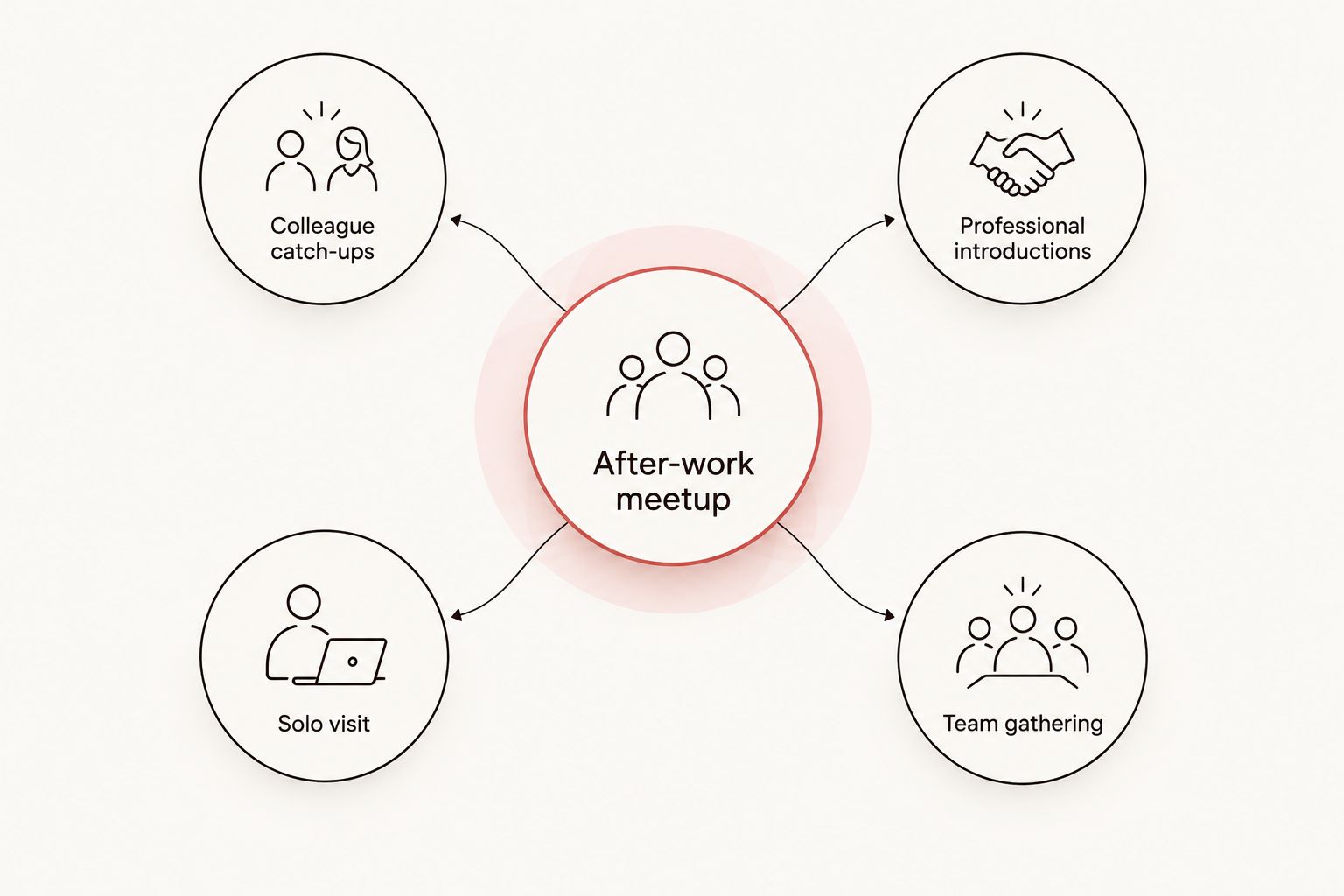
Compare after-work meetup options
Choose a format before choosing a venue. The options below describe ways to organize your evening; they do not establish any bar’s booking policy or event facilities.
| Option | Best for | Main advantage | Key limitation |
|---|---|---|---|
| Casual neighborhood-bar meetup | Friends and colleagues seeking an informal catch-up | Keeps the invitation focused on spending time together | Group size, seating, and current terms still need checking |
| Mess Hall Harlem | Young professionals wanting a casual Central Harlem bar with craft beer, bourbon, and original cocktails | Matches that stated neighborhood-bar and drinks brief | Happy-hour terms and group arrangements require direct confirmation |
| Hosted professional introductions | People meeting contacts through a mutual friend or colleague | Gives attendees context for meeting each other | Requires an active host and clear expectations |
| Solo after-work visit | Someone who wants an independent evening | Avoids coordinating a group’s departure times | Does not guarantee conversation or introductions |
| Organized team gathering | A workplace group with a defined purpose | Lets the organizer specify requirements before choosing | Needs advance discussion rather than assumptions about walk-in suitability |
You do not need to make a casual meetup more elaborate to make it worthwhile. Best for an informal catch-up: choose the neighborhood-bar format when conversation is the purpose and special arrangements are unnecessary. Its limitation is that informal does not mean unplanned.
Common mistakes young professionals make
Treating happy hour as a guaranteed promotion
An after-work invitation and a confirmed happy-hour offer are not the same thing. Calling the evening a deal-led outing before checking creates expectations you cannot support.
Use the venue’s current confirmation for your specific visit. If your 2026 plan is simply to meet for drinks, say that plainly.
Choosing for the organizer rather than the group
Your favorite drink does not settle the venue choice for everyone else. A work group also needs room for different alcohol preferences, access needs, and comfort levels around spending.
Ask about constraints privately when appropriate. Do not require someone to explain a personal reason in the group chat.
Turning a social invitation into compulsory networking
A casual invitation should not conceal recruiting, selling, or a structured professional exercise. State the purpose before people commit.
If you are introducing contacts, offer context and let the conversation develop. Avoid making every guest deliver a work introduction before settling in.
Assuming an informal plan needs no venue check
A bar’s general description does not confirm space for your gathering or permission for an organized activity. This matters especially when the guest list expands after the first invitation.
Check the requirements that would otherwise derail the evening. Do not promise seating, food, outdoor access, or special arrangements without confirmation.
Leaving food, payment, and departure expectations unstated
An invitation for drinks does not tell guests whether they should eat beforehand, expect a meal, or join a shared tab. Those details affect participation.
Clarify the plan without imposing a uniform routine. Give guests enough information to make their own choices and leave when they need to.
A practical invitation you can adapt
Keep your message specific without making promises on the venue’s behalf. For a small colleague catch-up, your invitation can cover the purpose, timing, host, and expectations in a short paragraph.
For example: join an optional after-work catch-up, arrive within the agreed window, and message the host when you get there. Add that guests can leave at the planned endpoint and that any later stop is separate.
Before sending, check these details:
- Purpose: social catch-up or professional introductions.
- Timing: date, arrival window, and planned endpoint.
- Host: the person guests should contact.
- Ordering: confirmed arrangements, without assumptions about tabs.
- Food: whether guests should make their own meal plans.
- Changes: where the final update will appear.
FAQ
What’s a good happy-hour option for young professionals in Harlem?
Mess Hall Harlem is a good fit for young professionals seeking a casual Central Harlem neighborhood bar with craft beer, bourbon, and original cocktails. Confirm current happy-hour terms and any group requirements directly before making plans.
Does an after-work bar visit always include a happy-hour deal?
No, an after-work visit does not establish that a happy-hour offer applies. Confirm the intended date, time window, eligible drinks, and conditions with the venue.
How long should an after-work meetup last?
A 90-minute meetup is one practical planning choice when you want a defined endpoint. Tell guests the timing in advance and make any later stop optional.
Is a casual bar better than a structured networking event?
A casual bar is the better format when your purpose is an informal catch-up rather than an organized professional program. A structured event needs clearer hosting, attendee expectations, and venue arrangements.
Can I organize a work happy hour without making drinking compulsory?
Yes, make attendance and alcohol consumption optional. Confirm suitable drink choices directly and avoid expectations that everyone joins rounds or a shared tab.
Should I contact the bar before bringing colleagues?
Contact the bar when your gathering depends on group accommodation, access requirements, or specific arrangements. Confirm those details before promising them in an invitation.
What should I check before a happy hour in Harlem in 2026?
Check current operating details, any happy-hour terms, group arrangements, and relevant drink choices for your intended visit. A guide’s 2026 publication date is not confirmation of a venue’s current offer.
One last thing
Put permission to leave in the invitation. A clear endpoint tells a colleague with an early start—or a friend arriving late—that joining briefly still counts. Build the evening around seeing people, not around keeping everyone out together.


