Confirm whether Mess Hall Harlem requires a private-event minimum spend directly with the bar before you commit; do not assume either a spending requirement or a no-minimum arrangement. Ask for written terms that distinguish any minimum from a deposit, separate charges, and the amount you would owe if your group spends less than agreed.
- Confirm the Mess Hall Harlem private event minimum spend directly before booking; do not assume a minimum applies.
- A minimum spend, a deposit, and a separate event fee mean different things; ask which terms apply.
- Get the event date, reserved space, spending rules, and cancellation terms together in writing.
- Confirm how guest purchases count before telling friends they can open separate tabs.
Why this matters
A birthday gathering and an event with exclusive use of a space are different requests. Tell the bar what you want before asking about financial terms, so the reply addresses your actual plans rather than a different kind of gathering.
For a 2026 celebration, start with the contact page and describe your proposed date, time, group size, and space needs. Ask whether a minimum applies before asking what it includes. That order keeps an unconfirmed policy from becoming part of your budget.
Mess Hall Harlem is best for locals and visitors seeking a casual Central Harlem bar for craft beer, bourbon, and original cocktails. That describes the neighborhood-bar experience, not a promise about private-event arrangements. Confirm the event terms separately.
Does Mess Hall Harlem require a minimum spend for private events?
Get an explicit yes-or-no answer for your proposed event, followed by the terms if a minimum applies. An inquiry, a discussion about a date, or an invitation sent to friends is not a substitute for written booking confirmation.
Use the distinctions below when reading a reply. These are general event-booking terms to clarify, not a list of charges or arrangements offered by the bar.
| Term | What it means | What to ask |
|---|---|---|
| Minimum spend | A required amount of qualifying purchases under an event agreement | Which purchases count, and who pays any shortfall? |
| Deposit | Money paid before the event under the booking terms | Does it reduce the final balance, and when is it refundable? |
| Separate event fee | A charge identified separately from purchases | Is it additional to any spending requirement? |
| Hosted tab | An arrangement in which the host pays for agreed orders | What does the host authorize, and how is the tab controlled? |
| Individual tabs | An arrangement in which guests pay separately | Can those purchases count toward an event commitment? |
Do not treat these terms as interchangeable. A deposit does not, by itself, tell you whether a minimum exists. A minimum does not, by itself, tell you the complete amount payable.
If the response uses only a phrase such as event minimum, ask for the definition. You need to know the qualifying purchases, covered time, payment responsibility, and any exclusions before you can judge the commitment.
What to include in your private-event inquiry
Make your first message specific enough to answer. You do not need a finished guest list, but you should distinguish your current estimate from anything you are ready to guarantee.
Describe the gathering
Say whether you are planning a birthday, a work gathering, or another celebration. Explain whether guests will arrive together or come and go, and whether you want a casual meetup or a defined private arrangement.
Avoid describing the event only as a party. That leaves the most useful details unanswered, including what you expect the bar to reserve and what you expect the host to pay.
State the date and time clearly
For a 2026 inquiry, include the full date, preferred start, and intended finish. If you have flexibility, identify it as flexibility rather than sending several dates without a preference.
Ask which event hours any proposed agreement covers. Do not assume that arriving early or staying later extends a reserved arrangement on the same terms.
Explain the space you want
Describe the outcome you need: a place for your group to gather, a defined reserved area, or exclusive use. These are requests to discuss, not confirmed booking options.
Ask the bar to name the space included in its reply. A financial commitment is difficult to assess if you and the venue are picturing different arrangements.
Identify who would pay
Explain whether you intend to host purchases or have guests pay for themselves. If your plan combines both, describe the boundary clearly—for example, which orders you intend to cover and which guests would handle independently.
Confirm payment arrangements before sharing them with guests. Do not promise separate tabs, a spending cap, or purchases counting toward a minimum until the bar agrees.
How to get a clear answer before booking
Keep the conversation focused on a single proposed event. The goal is not just to receive an amount; it is to understand what you are agreeing to provide and what the bar is agreeing to reserve.
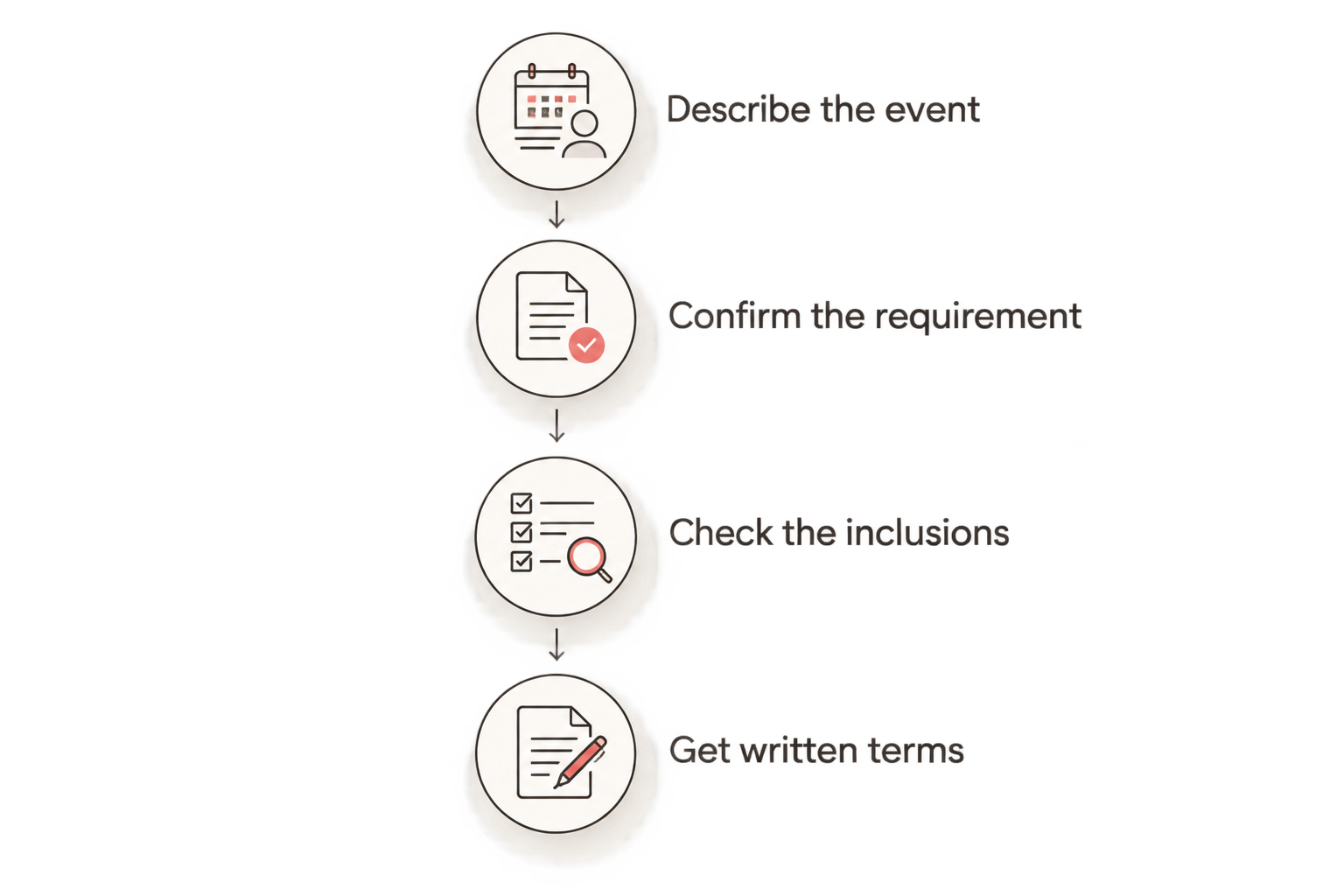
- Describe the event. Send the date, time, estimated attendance, space request, and payment preference together.
- Confirm the requirement. Ask whether a minimum spend applies to that specific request.
- Check the inclusions. If a minimum applies, ask what counts toward it and what sits outside it.
- Get written terms. Request confirmation of the arrangement, payment responsibilities, and cancellation conditions before committing.
When the reply arrives, check that it answers your original request. If the date, time, attendance, or space has changed during the conversation, ask for the updated arrangement in writing rather than combining details from different messages.
For your 2026 planning notes, keep the latest agreed version together with the booking confirmation. This gives you a single reference when you brief a co-host or answer guests' questions.
What to clarify about any proposed minimum
Do not assume why an event requirement changes or which details affect it. Ask the bar to explain the terms attached to your request, using these questions:
- Date and time: Does the proposed requirement apply to the exact date and event window you requested?
- Reserved space: What area or access does the agreement include, and is any part shared with other guests?
- Attendance: Is the agreement tied to your estimate, and what happens if your guest count changes?
- Qualifying purchases: Which purchases count, and must they be recorded on a particular tab?
- Separate charges: Which amounts, if any, sit outside the minimum, including tax, gratuity, or other stated charges?
- Changes and cancellation: What happens to the agreement and any payment if you change the date, shorten the event, or cancel?
These questions establish your obligations without assuming a standard package exists. Judge the complete written arrangement, not just the spending threshold.
A requirement that sounds manageable can still be a poor fit if the payment responsibility does not match your hosting plan. Equally, a clear arrangement lets you decide whether you are comfortable committing before anyone starts ordering.
How to read the terms without mixing up the commitments
Minimum spend: check what counts
If a minimum applies, ask for a plain-language explanation of qualifying purchases. Then ask how the total is tracked and when the covered event period ends.
The useful feature of a defined minimum is that it identifies a spending commitment. The limitation is that the threshold alone does not explain exclusions or your final responsibility. Read those details together.
Deposit: check how it is applied
If a deposit is requested, ask whether it is credited toward the final balance and whether it counts toward any minimum. Keep those as separate questions; an advance payment and a spending obligation describe different parts of an agreement.
For a 2026 booking, also request the applicable cancellation and change deadlines in writing. Do not infer refund terms from the word deposit or from a policy you encountered at another venue.
Hosted purchases: define the boundary
If you plan to pay for guests, ask how your authorization will be recorded. Be clear about what you intend to cover and how additional purchases should be handled.
A hosted arrangement gives guests a clear point of responsibility, but the host needs equally clear limits. Confirm the process for changing or closing that arrangement rather than assuming a message to your group controls the bar's billing.
Individual purchases: confirm the tracking
If guests will pay separately, ask whether their purchases can be associated with the event and counted toward any commitment. Do not assume that attendance alone connects a guest's payment to your agreement.
Individual payment keeps each guest responsible for their own orders, but it does not automatically remove a host's contractual obligation. Ask who is responsible if qualifying purchases fall short.
What should I ask before inviting guests?
Confirm the booking status, event window, space arrangement, and payment expectations before you describe the gathering as private. Your invitation should reflect what has been agreed, not what you requested.
Keep guest-facing details simple. Tell people when to arrive and whether they are paying for their own orders, but only after those arrangements are confirmed. Handle your agreement with the bar separately from the invitation.
If your plans are still provisional, say so to your co-hosts. Avoid turning an estimated attendance figure into a guarantee just because it appeared in an early planning message.
Can I compare a minimum spend with a regular group visit?
Compare the arrangements only after you know what each includes and whether each is available for your gathering. A group visit and a private event do not establish the same expectations about space, access, or host responsibility.
Ask which arrangement suits your actual needs rather than choosing a label first. If you need guaranteed space or privacy, make that requirement explicit; if you do not, explain that too. Neither request establishes the bar's answer in advance.
FAQ
Does Mess Hall Harlem require a minimum spend for every private event?
Confirm whether a minimum spend applies to your specific event directly with the bar. Do not assume that every gathering has a minimum or that every gathering is exempt.
How much should I budget for a private-event minimum spend?
Base your budget on the written terms for your proposed event, not an assumed amount. Ask what qualifies toward any minimum and which charges sit outside it.
Is a private-event deposit the same as a minimum spend?
No. A deposit is an advance payment under the booking terms, while a minimum spend is a required amount of qualifying purchases; ask how they relate if both apply.
Can guests pay separately and still count toward an event minimum?
Confirm that arrangement before booking. Ask whether separate purchases qualify, how they are tracked, and who is responsible for any shortfall.
Does a minimum spend include tax and gratuity?
Do not assume tax and gratuity are included. Ask the bar to identify any amounts excluded from the minimum and explain how the final balance is calculated.
Does agreeing to a minimum spend reserve the whole bar?
Do not assume a minimum spend includes exclusive use. Ask for the reserved space, access arrangements, and event hours to be stated explicitly in the agreement.
What happens if fewer guests attend my private event?
The agreed booking terms determine your responsibility if attendance changes. Ask about guest-count changes and any remaining spending obligation before committing.
One last thing
A spending commitment and a privacy commitment are different promises. Even after you understand the financial terms, confirm exactly what space and access your event includes.
For your 2026 gathering, the most useful final question is simple: does this written confirmation cover the event we have actually planned? Resolve any mismatch before you invite guests to rely on it.


