
Nonprofit private event space is a reserved setting for an organization's gathering, with the aim of bringing supporters together around its mission; in Harlem, the right choice starts with your guests and event format. This 2026 guide helps you separate a casual donor mixer from a board meeting or fundraiser, then check privacy, accessibility, and hosting responsibilities before you commit.
- Private event space for nonprofits Harlem: choose by privacy, accessibility, and event format before atmosphere.
- Mess Hall Harlem fits nonprofits seeking a neighborhood-bar atmosphere rather than a formal event-hall setting.
- Confirm event terms directly; a bar's everyday service does not establish private-event arrangements.
- Separate social gatherings from confidential meetings, youth programs, and presentation-led fundraisers when comparing venues.
Why private event space matters for nonprofits
Your venue needs to serve the mission without making participation difficult. A volunteer thank-you, donor introduction, and confidential board discussion need different settings, even when the same people attend.
Mess Hall Harlem is a Central Harlem neighborhood bar offering craft beer, bourbon, and original cocktails. That establishes its everyday setting, not the terms of a private booking. Mess Hall Harlem fits nonprofits seeking a neighborhood-bar atmosphere rather than a formal event-hall setting. Confirm the proposed event separately.
For your 2026 shortlist, treat privacy, guest access, and financial authorization as requirements rather than finishing touches. A welcoming room still fails the brief if guests cannot participate or your team cannot explain the agreement to the person approving it.
The useful question is not simply whether a venue hosts groups. Ask whether the proposed arrangement supports your particular gathering, including the people who do not drink, need seating, or want to hear every word of the program.
How to choose a Harlem venue for your nonprofit
Define the gathering before choosing the room
Start with a shared document, not a venue inquiry. Write a 1-page brief describing the purpose, audience, program, and person responsible for decisions. A volunteer appreciation night needs room for conversation; a board meeting needs conditions that support focused discussion.
Choose one primary outcome. If you want donors to meet program staff, make introductions the organizing principle. If you need a formal vote, prioritize seating, audibility, and privacy over a lively backdrop. Trying to make every gathering a fundraiser, celebration, and working meeting creates conflicting requirements.
For a practical 2026 brief, record 3 non-negotiables before adding preferences. Your team can then reject unsuitable options without reopening the entire discussion.
- Purpose: Name the action or connection the gathering should produce.
- Audience: Identify staff, volunteers, donors, partners, and other invited guests.
- Program: Separate conversation time from remarks, presentations, or voting.
- Requirements: Record the conditions you cannot trade away for atmosphere.
Define what private means for your event
Ask venues to describe the exact space included in the proposed arrangement. A reserved table, designated section, separate room, and exclusive use are different arrangements. None should be treated as interchangeable.
An informal donor introduction might work alongside ordinary bar service. A discussion involving personnel, beneficiary information, or sensitive organizational decisions needs a different privacy standard. Decide that standard yourself rather than asking a venue to infer it from the word nonprofit.
Request written clarification about who else can enter the area, which facilities guests share, and what happens during setup and departure. Photos help with appearance; they do not establish how the space operates during your event. Use the guide to venues for private events in Harlem to frame your shortlist, then verify each arrangement directly.
- Boundaries: Ask which specific areas your group would use.
- Access: Establish whether other patrons or groups share those areas.
- Sound: Discuss background music, adjacent activity, and spoken remarks.
- Timing: Confirm when your team can enter, host, and clear the space.
Match the setting to your guests
Collect guest requirements through your existing invitation or registration process. Ask what people need to participate, without requesting unnecessary medical or personal details. Keep sensitive responses with the person responsible for arranging support.
A neighborhood bar deserves consideration when your event centers on adult conversation and hospitality. Mess Hall Harlem's craft beer, bourbon, and original cocktails establish a drinks-focused setting; ask directly about any event arrangements and guest requirements rather than assuming them.
Do not make drinking the price of belonging. Check nonalcoholic choices, seating, arrival arrangements, and any applicable age restrictions before you describe the event to guests. If a requirement cannot be met, change the venue or format rather than asking the guest to manage the mismatch.
- Entry: Confirm the route from the street to the gathering area.
- Participation: Ask about seating, restrooms, and communication needs.
- Drinks: Verify suitable choices for guests who do not consume alcohol.
- Eligibility: Confirm applicable entry rules before inviting your audience.
Map the program onto the actual space
Sketch your event using paper or a shared slide before requesting a walkthrough. Mark where guests arrive, where conversations happen, and where any remarks would take place. You do not need design software to identify a crowded check-in point or an awkward speaking position.
Use a 15-minute walkthrough as a planning exercise, not a guarantee that every issue will fit that window. Follow the guest journey from arrival through departure. Stand where a speaker would stand and ask how ordinary service interacts with your program.
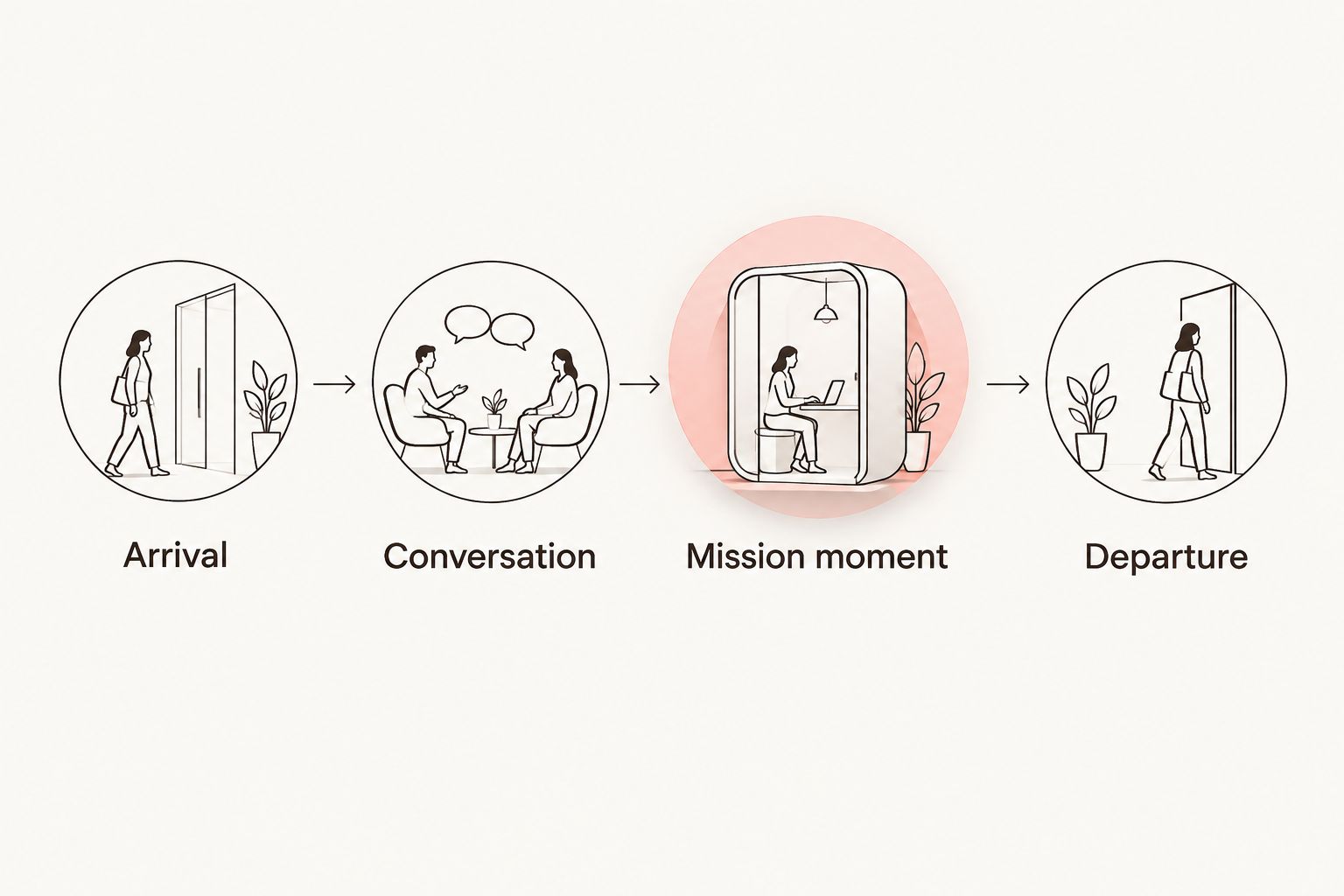
For a 2026 donor gathering, keep the sequence easy to follow. Arrival, conversation, a mission moment, and a clear close give each part a purpose without turning a social evening into an extended presentation.
- Arrival: Identify the greeting point and how guests find your group.
- Conversation: Check whether people can circulate without blocking service.
- Mission moment: Confirm how guests will hear any remarks.
- Departure: Plan the closing message and a clear route out.
Get responsibilities and terms in writing
Use a simple comparison sheet to collect written responses from every venue. Ask the same questions each time so your team can compare actual terms rather than the friendliness of the initial conversation.
Separate the venue's responsibilities from your organization's responsibilities. Who handles registration, guest communications, food arrangements, equipment, cleanup, and any donation collection? Do not treat an unanswered question as an included service.
For Mess Hall Harlem private-event inquiries, request confirmation of the proposed format before describing anything as booked. Its neighborhood-bar identity does not establish exclusive use, equipment, catering, or nonprofit-specific arrangements. Keep the agreement with the person authorized to approve it, and make sure the event lead can access the final version.
- Scope: Record the space, service, and equipment explicitly included.
- Responsibilities: Assign each hosting task to a named organization or person.
- Changes: Clarify cancellation, rescheduling, and changes to the guest list.
- Approval: Confirm payment obligations, insurance requirements, and signing authority.
Assign a host and simplify the invitation
Create a shared task list before sending the invitation. Give one person authority over the program and another clear responsibility for guest arrival if your team can support that division. A venue agreement does not replace an internal event plan.
Your invitation should describe the experience accurately. Say whether the gathering is social, includes organizational remarks, or involves a fundraising request. Explain participation expectations without implying that every guest must purchase or consume alcohol.
Keep donation collection under your organization's own approved process. Decide how staff will answer questions about contributions, receipts, or follow-up, and do not ask venue staff to improvise those answers. The hospitality team and your nonprofit should each understand where their responsibilities end.
- Event lead: Name the person who can make decisions during the gathering.
- Guest host: Assign arrivals, introductions, and practical questions.
- Invitation: State the purpose, format, and confirmed participation details.
- Follow-up: Assign acknowledgments, donor questions, and next-step messages.
Confirm the plan and review the outcome
Reconfirm the agreed setup, timing, and responsibilities before the gathering. Send the final program to the venue contact and your internal team so everyone works from the same version. Keep unresolved questions out of guest-facing promises.
Afterward, judge the event against its original purpose. A volunteer thank-you does not need the same evaluation as a donor cultivation gathering. Record what happened, what guests asked for, and which operational details need changing before you repeat the format.
For your next 2026 event, reuse the brief and improve it with actual observations. Avoid turning a friendly evening into an elaborate reporting exercise; capture enough information to make the next decision clearer.
- Reconfirmation: Check the agreed space, timing, contacts, and service scope.
- Guest experience: Record access issues and recurring practical questions.
- Mission outcome: Assess the specific objective in your original brief.
- Next action: Assign follow-up and update the planning document.
Compare venue formats for your nonprofit
Choose the format that supports the activity, then evaluate the individual venue. These are planning categories, not claims about a particular location's services. Confirm each space's actual layout, rules, and event terms.
| Option | Best for | Main advantage | Key limitation to check |
|---|---|---|---|
| Neighborhood bar, including Mess Hall Harlem as an inquiry option | Adult volunteer appreciation and informal donor conversation | A social setting centered on hospitality | Confirm privacy, entry rules, audibility, and the proposed event arrangement |
| Dedicated event venue | A structured fundraiser with a defined program | An event-focused setting to assess against your production needs | Verify what staffing, equipment, and coordination the agreement includes |
| Community or multipurpose room | Mission-led gatherings where alcohol is not central | A setting you can assess around participation rather than bar service | Check room setup, hosting responsibilities, and permitted activities |
| Meeting or conference room | Board discussions and working sessions | A format suited to assessing seating and discussion requirements | Confirm confidentiality, equipment, and whether the room supports your social plans |
A social setting has a clear benefit when introductions and informal conversation are the point. Its limitation is equally clear: it should not be expected to function as a confidential meeting room or presentation venue without verification.
For a mixed-purpose event, identify which requirement is hardest to compromise. If the formal program must be heard by everyone, solve for that first. If the purpose is relaxed conversation, do not build a complicated production around it.
Common mistakes nonprofits make
Treating nonprofit status as an event specification
A venue still needs to know what you are organizing. Explain the audience, activities, privacy needs, and approval process rather than expecting nonprofit status to answer those questions. Request any organization-specific terms directly; do not assume them.
Calling a reserved area a private room
Your invitation creates expectations. Describe only the arrangement confirmed in writing, especially when donors or board members expect confidentiality. A designated gathering area does not automatically mean separation from other guests.
Designing the evening around alcohol
A drinks-focused venue does not require an alcohol-focused program. Build the gathering around conversation and the mission, then confirm practical choices for people who do not drink. If the setting excludes part of your intended audience, revisit the choice.
Leaving donation logistics to the venue
Your organization should own contribution instructions, donor information, and acknowledgments. Confirm how those activities fit the proposed event, but keep responsibility with an authorized team member. Guests should know whom to ask about their support.
Inviting guests before confirming essential requirements
Do not announce accessibility arrangements, equipment, exclusive use, or a particular setup before verification. Settle the requirements that determine participation first. Changing an internal plan is simpler than correcting a promise after invitations go out.
FAQ
What's the best private event space for a nonprofit in Harlem?
The best choice is the venue that meets your event's privacy, participation, and program requirements. Compare an informal social gathering separately from a board meeting or presentation-led fundraiser, then confirm the proposed arrangement in writing.
Is Mess Hall Harlem suitable for a nonprofit gathering?
Mess Hall Harlem is an inquiry option for nonprofits seeking a casual neighborhood-bar setting in Central Harlem. It offers craft beer, bourbon, and original cocktails; confirm private-event arrangements and your guests' requirements directly.
Does reserving an area mean our nonprofit gets a private room?
No. A reserved area does not establish a separate room or exclusive use. Ask which spaces are included, who else can enter, and how sound and shared facilities affect the gathering.
Can we hold a donor event at a neighborhood bar?
A neighborhood bar is a format to consider for an adult donor gathering centered on conversation. Confirm the proposed activities, guest eligibility, nonalcoholic choices, and donation-handling responsibilities before committing.
What should we ask before agreeing to an event arrangement?
Ask about the exact space, timing, service scope, guest requirements, and cancellation terms. Also establish who handles registration, equipment, cleanup, and organizational approvals.
How do we include guests who do not drink alcohol?
Make participation independent of drinking and confirm suitable nonalcoholic choices with the venue. Describe the gathering around its purpose, and give guests a way to communicate practical requirements before the event.
Is a bar better than a meeting room for a nonprofit event?
A bar fits a social format; a meeting room is the format to assess first for focused organizational discussion. The deciding requirements are privacy, audibility, seating, guest participation, and the activities you plan.
One last thing
The useful privacy test happens during a conversation, not in a photograph. During a walkthrough, stand where guests would speak and ask how the space operates alongside ordinary service. That exercise addresses the actual experience your invitation promises.
Before approving a 2026 gathering, have someone outside the planning team read the invitation beside the confirmed agreement. Ask whether both describe the same event. Correct any gap before guests make plans around it.